
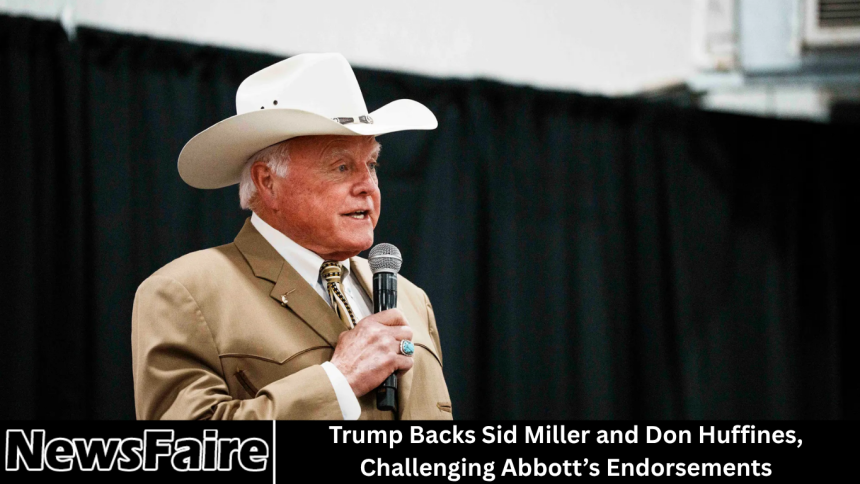
In a significant development within Republican politics, Donald Trump stirred the political landscape of Texas by endorsing Sid Miller and Don Huffines in key statewide races. What made this move especially noteworthy was that it directly challenged the endorsements of Governor Greg Abbott.
This political clash was not merely about individual candidates—it represented a deeper contest between competing visions within the Republican Party. On one side stood Trump’s populist, grassroots-driven movement; on the other, Abbott’s more traditional, establishment-backed governance approach.
As the 2026 primaries unfolded, this battle became a defining moment, shedding light on the balance of power, voter priorities, and the future direction of the GOP in Texas and beyond.
More Read: Texas Tech Regents Hold Off on Decision Regarding Curriculum on Race and Gender
The Political Landscape of Texas
Texas has long been a Republican stronghold, but its internal political dynamics are far from simple. Over the years, the state GOP has evolved into a coalition of different factions, each with its own priorities and leadership style.
At the center of this dynamic are two influential forces:
- The state-level establishment led by Greg Abbott
- The national populist movement led by Donald Trump
Abbott has built his reputation on governance, economic growth, and policy continuity. Trump, meanwhile, has energized voters with a message centered on nationalism, border security, and political disruption.
While both leaders share many conservative values, their approaches often diverge—especially when it comes to candidate selection and political strategy.
Who Is Sid Miller?
Sid Miller has been a prominent and sometimes controversial figure in Texas politics. Serving as Agriculture Commissioner, Miller has focused on policies affecting rural communities, farming industries, and food regulation.
Key Characteristics
- Strong supporter of conservative values
- Vocal advocate for border security
- Known for his direct and sometimes polarizing communication style
Miller has also been a loyal ally of Donald Trump, which played a major role in securing Trump’s endorsement. For Trump supporters, Miller represented continuity with the broader “America First” agenda.
Despite his incumbency, Miller faced stiff competition, particularly from candidates aligned with Abbott’s political network.
Who Is Don Huffines?
Don Huffines is a businessman and former state senator known for his uncompromising conservative stance. Over the years, he has built a reputation as a reformer willing to challenge even his own party’s leadership.
- Core Policy Positions
- Reducing property taxes
- Limiting government spending
- Promoting economic freedom
Huffines previously ran against Greg Abbott in a gubernatorial primary, positioning himself as a more ideologically pure conservative. Although he did not win that race, he gained significant recognition among grassroots voters.
Trump’s endorsement boosted Huffines’ campaign, giving him greater visibility and reinforcing his credibility among Republican voters.
Trump’s Endorsement Strategy
Donald Trump’s endorsements were strategic and timely. Announced shortly before the primaries, they were designed to maximize impact and influence voter decisions at a critical moment.
Objectives Behind the Endorsements
- Reward Loyalty: Trump has consistently prioritized candidates who have supported him and his policies.
- Shape the GOP’s Direction: By backing Miller and Huffines, Trump signaled his preference for candidates aligned with his vision.
- Challenge Establishment Power: The endorsements served as a direct challenge to Greg Abbott’s influence within Texas politics.
Trump’s involvement also underscored his continued relevance in Republican politics, even outside presidential elections.
Abbott’s Political Influence
Greg Abbott has long been a dominant figure in Texas politics. As governor, he has cultivated a powerful network of supporters, donors, and political allies.
- Abbott’s Approach
- Focus on policy-driven governance
- Strong fundraising capabilities
- Strategic endorsements aimed at maintaining party unity
Abbott’s endorsements carried significant weight, particularly among establishment Republicans and institutional voters. His backing of alternative candidates set the stage for a high-stakes political showdown.
The Stakes of the 2026 Primaries
Although the races in question were not for the governorship, they were still highly significant.
Economic Control
The comptroller plays a crucial role in managing state finances, taxation, and budget allocation.
Agricultural Policy
The agriculture commissioner oversees key sectors affecting rural economies and food systems.
Party Direction
Perhaps most importantly, these races served as a referendum on the future of the Republican Party in Texas.
Campaign Dynamics
The campaigns of Miller and Huffines focused heavily on grassroots engagement, conservative messaging, and alignment with Trump’s policies.
Meanwhile, Abbott-backed candidates emphasized:
- Experience and stability
- Policy continuity
- Institutional support
The result was a clear ideological contrast, giving voters a meaningful choice within the same party.
Election Outcomes
The results of the primaries reflected a divided but competitive Republican electorate.
- Don Huffines achieved a significant victory in his race
- Sid Miller faced a tougher outcome and did not secure re-election
These mixed results demonstrated that both Trump and Abbott retained considerable influence—but neither held absolute control over the party.
Trump vs Abbott: A Broader Power Struggle
The endorsements highlighted a broader struggle within the Republican Party.
- Trump’s Strengths
- Strong grassroots support
- High visibility and media influence
- Ability to energize voters
- Abbott’s Strengths
- Institutional authority
- Established political network
- Policy-driven leadership
Rather than one side dominating, the Texas primaries showed a balance of power between the two.
The Role of Endorsements in Modern Politics
Political endorsements have always been important, but Trump has elevated their impact.
- Why Endorsements Matter
- They guide undecided voters
- Increase candidate visibility
- Signal ideological alignment
However, the Texas results demonstrated that endorsements are not decisive on their own. Factors such as campaign strategy, funding, and local issues also play a crucial role.
Implications for the Republican Party
Continued Internal Competition
The GOP is likely to see ongoing competition between its different factions.
Stronger Voter Engagement
Contested primaries can increase voter participation and political awareness.
Evolving Party Identity
The balance between populism and establishment politics will continue to shape the party’s future.
Impact Beyond Texas
Texas is often seen as a bellwether for Republican politics nationwide. The Trump-Abbott dynamic could influence:
- Candidate selection in other states
- National campaign strategies
- The overall direction of the GOP
As one of the largest states in the country, Texas plays a critical role in shaping political trends.
Frequently Asked Question
Why did Donald Trump endorse Sid Miller and Don Huffines?
Trump endorsed them because they aligned closely with his political ideology and had demonstrated loyalty to his movement.
Who is Greg Abbott and why is he important in this context?
Greg Abbott is the Governor of Texas and a key figure in the Republican Party, making his endorsements highly influential.
What positions were being contested?
The races included important statewide roles such as agriculture commissioner and comptroller.
Did Trump’s endorsements guarantee victory?
No, the results showed that endorsements are influential but not decisive.
What does this mean for the Republican Party?
It highlights internal competition and differing visions within the party.
Why is Texas politically significant?
Texas is one of the largest and most influential states in the U.S., often shaping national political trends.
What could happen next?
Future elections may continue to reflect competition between Trump-aligned candidates and establishment-backed leaders like Abbott.
Conclusion
The endorsement battle between Donald Trump and Greg Abbott marked a pivotal moment in Texas politics. By backing Sid Miller and Don Huffines, Trump directly challenged the state’s political establishment and tested his influence among Republican voters. The mixed election results revealed a party that is both divided and dynamic—one where multiple voices and visions compete for dominance. Rather than signaling weakness, this competition may ultimately strengthen the GOP by encouraging debate, engagement, and evolution.