

Curious about supercomputers and why experts call them the most powerful machines on Earth? Many people assume these systems are too complex to understand. In reality, the idea is simple: a supercomputer is an extremely powerful computer built to solve massive problems at incredible speed.
This guide explains what a supercomputer is, how it works, its history, types, uses, and its growing role in artificial intelligence and scientific discovery.
Read More: Join the Revolution: Share Your Voice and Inspire—Write for Us Today!
What Is a Supercomputer?
A supercomputer is a high-performance computer designed to process enormous amounts of data and perform billions or even trillions of calculations per second. Unlike regular desktop or laptop computers, supercomputers handle complex scientific and engineering problems that require extreme speed and accuracy.
Organizations use supercomputers for tasks such as weather forecasting, climate modeling, drug discovery, nuclear research, and space exploration. These systems operate with thousands—or even millions—of processors working together simultaneously.
In simple terms, if a regular computer solves one problem at a time, a supercomputer solves thousands at once.
How Do Supercomputers Work?
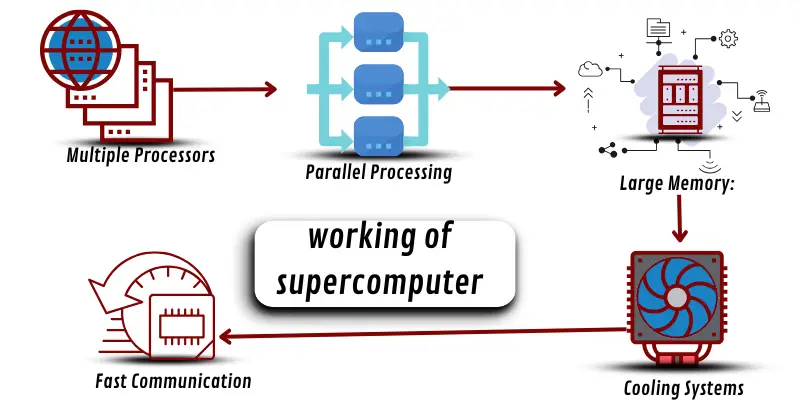
Supercomputers rely on advanced architecture and parallel processing to achieve extraordinary performance. Instead of depending on a single powerful processor, they combine many processors that work together as one system.
Key Components of a Supercomputer
Multiple Processors
Thousands of processors divide large problems into smaller tasks and solve them simultaneously.
Parallel Processing
Parallel computing allows different parts of a calculation to run at the same time, dramatically increasing speed.
Massive Memory Capacity
Supercomputers include enormous memory systems to store and access large datasets instantly.
High-Speed Interconnects
Processors communicate through ultra-fast networks to prevent delays.
Advanced Cooling Systems
Because these machines generate significant heat, liquid or specialized cooling systems maintain safe operating temperatures
This combination of technologies enables supercomputers to perform quadrillions of calculations per second, measured in FLOPS (Floating Point Operations Per Second).
History of Supercomputers
Supercomputing began in the 1960s with the creation of the CDC 6600, designed by Seymour Cray. At the time, it was considered the fastest computer in the world, performing around three million calculations per second.
In the 1970s and 1980s, advancements in vector processing led to machines like the Cray-1, which set new performance standards.
By the 2000s, countries began competing to build the most powerful systems. Today, modern supercomputers perform calculations at exascale levels—meaning they can execute more than one quintillion calculations per second.
Supercomputers have evolved from room-sized experimental systems to massive data centers capable of solving global-scale challenges.
Types of Supercomputers
Different supercomputers serve different purposes. Below are the main categories:
Clustered Supercomputers
Clusters connect multiple standard computers to function as one powerful system. They are flexible, scalable, and widely used in research institutions.
Vector Processing Supercomputers
Vector systems handle mathematical calculations extremely efficiently, especially for scientific simulations.
Massively Parallel Supercomputers
These systems use thousands of processors working simultaneously on separate parts of a problem. Most modern supercomputers fall into this category.
Special-Purpose Supercomputers
Designed for specific tasks such as weather forecasting or molecular modeling, these machines optimize performance for one primary objective.
Distributed or Virtual Supercomputers
Networks of computers connected via the internet can collectively perform complex computations.
Each type supports different industries, but all share one goal: solving problems beyond the reach of ordinary computers.
Uses of Supercomputers
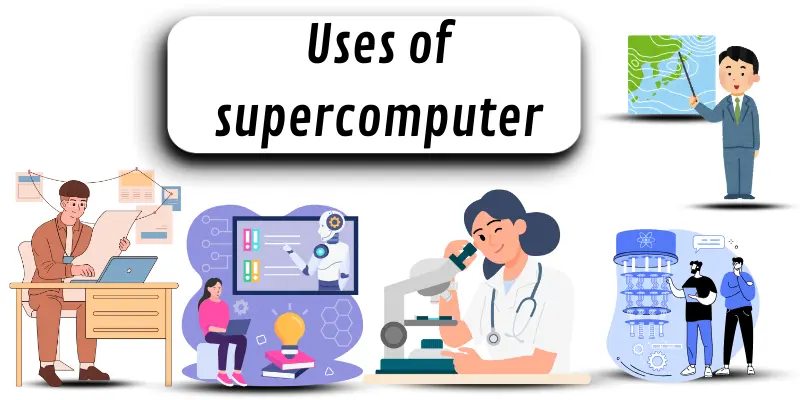
Supercomputers play a critical role in modern science, technology, and innovation. Their ability to process massive datasets makes them essential in several fields.
Weather Forecasting
Meteorologists use supercomputers to simulate atmospheric conditions and predict storms, hurricanes, and climate changes with high accuracy.
Climate Research
Researchers analyze decades of climate data to understand global warming and environmental shifts.
Medical Research
Supercomputers accelerate drug discovery, genetic research, and disease modeling, helping scientists develop treatments faster.
Space Exploration
Space agencies simulate rocket launches, planetary movements, and cosmic events using high-performance computing systems.
Engineering and Manufacturing
Automotive and aerospace industries use simulations to test designs virtually before building physical prototypes.
Artificial Intelligence
Supercomputers train advanced AI models by processing enormous datasets in record time.
Energy Research
Scientists use supercomputers to explore renewable energy sources and improve energy efficiency.
Without supercomputers, many modern scientific breakthroughs would take decades longer to achieve.
Most Powerful Supercomputers of the 21st Century
Several countries lead the global race in high-performance computing. Some of the most powerful systems include:
Fugaku (Japan)
Developed by RIKEN and Fujitsu, Fugaku ranked among the world’s fastest supercomputers and supports research in medicine and disaster prevention.
Summit (USA)
Located at Oak Ridge National Laboratory, Summit delivers exceptional performance for scientific research and AI development.
Sierra (USA)
Designed for nuclear research and national security simulations.
Sunway TaihuLight (China)
Known for its powerful processing capability and use in advanced engineering and climate modeling.
These machines demonstrate how supercomputing drives global innovation and technological leadership.
Role of Supercomputers in Artificial Intelligence
Artificial Intelligence depends heavily on computational power. Training AI models requires processing enormous volumes of data. Supercomputers provide the speed and memory necessary for this task.
Faster Training
AI systems learn by analyzing patterns in data. Supercomputers reduce training time from months to days or even hours.
Improved Accuracy
Greater computing power allows deeper neural networks, improving prediction accuracy.
Real-World Applications
From self-driving cars to medical diagnosis systems, AI applications rely on high-performance computing to function effectively.
As AI continues to evolve, supercomputers remain central to its growth and advancement.
Future of Supercomputers
Supercomputing technology continues to advance rapidly. Researchers focus on improving speed, efficiency, and sustainability.
Exascale Computing
Next-generation systems operate at exascale performance, achieving more than one quintillion calculations per second.
Energy Efficiency
Engineers design new cooling systems and processors to reduce energy consumption.
Quantum Computing Integration
Quantum computing may complement traditional supercomputers by solving specific problems even faster.
Expanded Applications
Future supercomputers will likely support smart cities, advanced robotics, and solutions to global challenges such as climate change and pandemics.
The future promises faster, smarter, and more energy-efficient systems capable of solving humanity’s most complex problems.
Differences Between Supercomputers and General-Purpose Computers
| Feature | Supercomputers | General-Purpose Computers |
| Speed | Much faster | Slower |
| Power | Very powerful, can do many tasks at once | Less powerful, does one task at a time |
| Purpose | Used for special jobs like weather or medicine | Used for everyday tasks like typing, gaming, and browsing |
| Size | Very large | Small, fits on a desk |
| Cost | Very expensive | Much cheaper |
Frequently Asked Questions:
What is a supercomputer in simple words?
A supercomputer is an extremely powerful computer that performs massive calculations at incredibly high speeds. It solves complex problems that regular computers cannot handle efficiently.
How is a supercomputer different from a normal computer?
Supercomputers use thousands of processors working together, while regular computers typically rely on one or a few processors. They are built for scientific research, simulations, and large-scale data analysis rather than everyday tasks like browsing or document editing.
What are supercomputers mainly used for?
Supercomputers support weather forecasting, climate modeling, medical research, space exploration, engineering simulations, artificial intelligence training, and energy research.
Who uses supercomputers?
Governments, research institutions, universities, defense organizations, and large technology companies use supercomputers for advanced scientific and industrial projects.
How fast is a supercomputer?
Modern supercomputers can perform quadrillions or even quintillions of calculations per second. Their speed is measured in FLOPS (Floating Point Operations Per Second).
Where are supercomputers located?
Supercomputers are usually housed in specialized research facilities or national laboratories because they require advanced cooling systems, large space, and significant power supply.
What is the most powerful supercomputer in the world?
The ranking of the most powerful supercomputer changes frequently as new systems are developed. Countries like the United States, China, and Japan lead the global supercomputing race.
Conclusion
Supercomputers stand as the ultimate symbols of technological power and innovation. Built to process enormous volumes of data at extraordinary speeds, these advanced systems solve problems far beyond the reach of ordinary computers. From predicting extreme weather and advancing medical breakthroughs to powering artificial intelligence and space exploration, supercomputers drive progress across industries. As computing technology continues to evolve, supercomputers will become even faster, smarter, and more energy-efficient. Their expanding capabilities will help researchers tackle global challenges, accelerate scientific discovery, and transform the digital world. Understanding what a supercomputer is reveals not just a machine, but a powerful force shaping the future of humanity.