
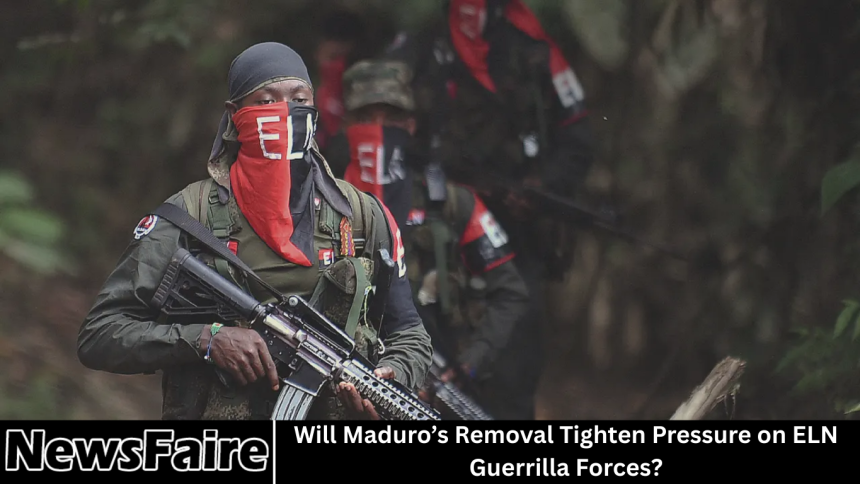
The removal of Nicolás Maduro in 2026 marked a dramatic turning point in Latin American geopolitics. His ouster reshaped Venezuela’s political landscape and raised urgent questions about security across the region. One of the most pressing issues is whether this shift will increase pressure on the National Liberation Army (ELN).
A long-standing insurgent force operating along the Colombia–Venezuela border. At first glance, the answer seems straightforward: removing a leader accused of tolerating or supporting armed groups should weaken those groups. However, the reality is far more complex.
While Maduro’s departure may create opportunities to challenge the ELN, structural weaknesses, political uncertainty, and regional dynamics suggest that any pressure applied will be gradual and uneven rather than immediate or decisive.
More Read: White House Sees Political Advantage in Israel Initiating Strike on Iran First
Understanding the ELN: History and Evolution
The National Liberation Army was founded in 1964, inspired by Marxist ideology and revolutionary movements across Latin America. Like many insurgent groups of its time, it initially aimed to overthrow the government and establish a socialist state.
Over the decades, however, the ELN evolved into a hybrid organization. While it still maintains political rhetoric, its operations increasingly rely on:
- Drug trafficking
- Illegal gold mining
- Kidnapping for ransom
- Extortion of local communities
After the 2016 peace agreement between the Colombian government and the Revolutionary Armed Forces of Colombia (FARC), the ELN expanded its influence. With FARC demobilizing, power vacuums emerged—particularly in border regions—which the ELN quickly filled.
Why Venezuela Became a Strategic Base
Venezuela has played a critical role in the ELN’s growth over the past decade. Under Nicolás Maduro and earlier Hugo Chávez, relations between the Venezuelan state and Colombian insurgent groups became increasingly complex.
Key Advantages for the ELN in Venezuela:
- Safe havens: Remote border regions allowed fighters to evade Colombian military operations
- Weak state control: Limited governance in rural areas created opportunities for expansion
- Access to resources: Illegal mining zones, especially gold, became major revenue sources
- Cross-border mobility: Fighters could move between countries with relative ease
This environment enabled the ELN to strengthen its operational capacity and financial base.
The Maduro–ELN Relationship
The relationship between Maduro’s government and the ELN is widely seen as pragmatic rather than ideological.
Benefits for Maduro:
- Delegated control of remote territories
- Support in managing local security challenges
- Revenue from illicit economies during economic crisis
Benefits for the ELN:
- Protection from external military pressure
- Freedom to expand operations
- Access to profitable illegal industries
This mutually beneficial arrangement helped both sides maintain influence, particularly in regions where formal state presence was weak.
What Changes After Maduro’s Removal?
The removal of Nicolás Maduro disrupts this balance—but it does not automatically dismantle the networks built over years.
Loss of Political Cover
One of the most immediate impacts is the potential loss of political protection for the ELN. A new or transitional government may:
- Distance itself from insurgent groups
- Seek international legitimacy by cracking down on militancy
- Reevaluate informal alliances
However, such changes depend heavily on the priorities and stability of the new leadership.
Increased International Pressure
Countries like the United States and Colombia are likely to push for stronger action against armed groups.
Colombian President Gustavo Petro has already emphasized the importance of regional cooperation in dealing with insurgencies. With Maduro gone, coordination between Venezuela and Colombia could improve—at least in theory.
Institutional Weakness Remains
Despite leadership change, Venezuela’s deeper challenges persist:
- Fragile institutions
- Economic instability
- Limited control over rural territories
These factors restrict the government’s ability to conduct sustained operations against the ELN.
Signs That Pressure Could Increase
Even with constraints, several developments suggest that pressure on the ELN may grow.
Cross-Border Cooperation
Improved relations between Venezuela and Colombia could lead to:
- Joint military operations
- Intelligence sharing
- Coordinated border security efforts
Such cooperation would limit the ELN’s ability to use Venezuela as a safe haven.
Disruption of Illicit Economies
The ELN relies heavily on illegal revenue streams. If Venezuela moves toward economic reform and transparency:
- Illegal mining operations may face stricter oversight
- Drug trafficking routes could be targeted
- Financial networks might be disrupted
This would weaken the group indirectly, even without direct military confrontation.
Strategic Realignment
A new Venezuelan leadership may view the ELN as a liability rather than an asset, particularly if:
- It seeks foreign investment
- It aims to normalize diplomatic relations
- It wants to rebuild state authority
Why the ELN May Still Endure
Despite these pressures, the ELN is unlikely to collapse quickly.
Deep Territorial Roots
The group is deeply embedded in border regions, with established networks and local influence. Removing it requires more than military force—it demands long-term governance and development.
Fragmented Power Structures
Post-Maduro Venezuela may experience internal divisions:
- Competing political factions
- Military interests
- Regional power brokers
These divisions can hinder a unified strategy against the ELN.
Adaptability of the ELN
The ELN has survived for decades by adapting to changing conditions. It can:
- Shift operations to new areas
- Diversify income sources
- Form alliances with other armed groups
Maduro’s removal is a challenge—but not an existential threat.
Risk of Escalation
Increased pressure could lead to unintended consequences:
- Intensified violence
- Clashes with other armed groups
- Civilian displacement
Rather than weakening the ELN, poorly coordinated actions could destabilize the region further.
Regional Implications
Colombia
For Colombia, this situation presents both opportunity and risk. While increased cooperation could help weaken insurgents, instability in Venezuela could spill across the border.
Peace negotiations with the ELN may also become more complicated if pressure increases.
Venezuela
Venezuela faces a difficult choice:
- Maintain short-term stability by tolerating armed groups
- Or pursue long-term reform by confronting them
- The path chosen will shape the country’s future security environment.
United States
The United States is likely to prioritize:
- Counter-narcotics operations
- Regional stability
- Economic recovery in Venezuela
While addressing the ELN is part of this agenda, it may not be the top priority compared to broader strategic goals.
Possible Future Scenarios
Gradual Containment
Steady pressure reduces the ELN’s capabilities without eliminating it.
Selective Crackdown
Certain factions are targeted while others remain active.
Escalation
Conflict intensifies, leading to instability and humanitarian concerns.
Minimal Change
Despite political shifts, the ELN continues operating much as before.
Frequently Asked Question
What is the ELN?
The National Liberation Army is a Colombian insurgent group founded in 1964, involved in both political and criminal activities.
Why is Venezuela important to the ELN?
Venezuela provides safe havens, access to resources, and opportunities for cross-border operations.
Did Maduro support the ELN?
While not officially acknowledged, his government was widely believed to tolerate or indirectly support the group.
Will the ELN weaken after Maduro’s removal?
It may face increased pressure, but it is unlikely to collapse quickly due to its strong regional presence.
How could Colombia respond?
Under Gustavo Petro, Colombia may push for greater cooperation and joint operations.
What challenges does Venezuela face in confronting the ELN?
Weak institutions, economic struggles, and limited territorial control make enforcement difficult.
What is the most likely outcome?
A gradual increase in pressure on the ELN, but with no immediate or complete resolution.
Conclusion
The removal of Nicolás Maduro creates an opportunity to increase pressure on the National Liberation Army—but it does not guarantee success. The ELN’s resilience is rooted in deeper structural realities: weak governance, economic incentives tied to illicit activities, and regional instability. While international cooperation and political change may tighten constraints on the group, meaningful results will depend on long-term commitment and institutional rebuilding.